|
Home > Earth > Gemstones > Sapphires
Gifts from the Earth: Where Do Gemstones Come From?
For thousands of years humans have collected, hoarded, traded, stolen and looted cut and polished stones of various sorts. By far, the stones most highly prized by cultures around the world are those we classify as gemstones. Wars have been waged, and families torn apart by their allure while the mystique and power we have imbued in these glittering stones have spawned legends. Unmatched beauty, purity, rarity, and endurance are the ultimate qualities of the most highly prized gemstones. Join us as we profile the rarest and most precious of gemstones and explore the geologic processes that forge them...
Corundum (Sapphire)
Al2O3; Aluminum Oxide
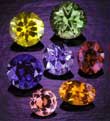 This is not a mineral you often hear about, but it is the second hardest natural mineral known to man. Aluminum Oxide, as it is known in mineralogy circles, is formed by both volcanic processes deep in the earth and the high pressure and temperature, conditions of metamorphic processes. As liquid magma deep within the earth slowly cools the minerals dissolved within cool into crystals. The purest and most translucent forms of corundum are created by recrystallization of minerals during the metamorphosis of rocks that are of igneous origin. It is a process that takes millions of years and only a few places in the world have rock outcrops where these rare crystals are exposed by weathering. This is not a mineral you often hear about, but it is the second hardest natural mineral known to man. Aluminum Oxide, as it is known in mineralogy circles, is formed by both volcanic processes deep in the earth and the high pressure and temperature, conditions of metamorphic processes. As liquid magma deep within the earth slowly cools the minerals dissolved within cool into crystals. The purest and most translucent forms of corundum are created by recrystallization of minerals during the metamorphosis of rocks that are of igneous origin. It is a process that takes millions of years and only a few places in the world have rock outcrops where these rare crystals are exposed by weathering.
The pure form of the mineral corundum is clear and colorless, but mineral 'impurities' that seep into the Aluminum Oxide as the rock cools give it its fabulous colors. The distinctive colors of many gemstones are caused by the presence of transition metals as impurities in an otherwise transparent crystal lattice. This is a called crystal-field or, a ligand-field effect. Corundum comes in many different colors, all of which are highly prized if they are free of intrusions and translucent or transparent. When trace amounts of titanium and iron get into the Al2O3 crystal lattice during its formation a beautiful blue sapphire is formed...more about sapphires->
|

 Extreme Science is a registered trademark. All rights reserved.