
|
||
Home > Earth > Gemstones > Emeralds How Emeralds are Formed Beryl is the Mineral that Makes Emeralds Beryllium Aluminum Silicate> Beryllium is another rare and very hard mineral that forms in several different ways:
What Colors the Emeralds? The element that gives emeralds their beautiful green color is the same element that turns corundum into red rubies - chromium. The base mineral composition of rubies differs from that of emeralds (Al2O3 for rubies, Be3Al2Si6O18 for emeralds) so the chromium trapped within the crystal lattice of each absorbs different colors of the visible spectrum of light; the chromium in rubies reflect red and the chromium in emeralds reflect green. Unlike other precious gemstones, impurities, inclusions (gas bubbles and other minerals), small fractures, and other intrusions into emerald crystals do not detract from the value of a stone. On the contrary, the minor imperfections found deep in the interior of a transparent, natural emerald are what give it "character" and assure the owner that is truly unique, original and unaltered stone. The largest uncut emerald was found in Carnaiba, Brazil in 1974. It was an incredible 86,136-carat natural beryl crystal. The stone was eventually valued at $1,120,080 USD. The largest emerald crystal ever discovered was 7,025 carats and was found in a mine in Colombia. |
Get Your Degree!Find schools and get information on the program that’s right for you. Powered by Campus Explorer
|
Copyright © 1998-2015.  Extreme Science is a registered trademark. All rights reserved. Extreme Science is a registered trademark. All rights reserved. |
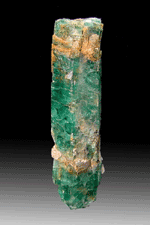 In its purest natural (uncut) form, this mineral forms long, hexagonal prisms and is known as goshenite. It also comes in a variety of colors, depending upon the mineral impurities that have entered the crystal during its formation. Unlike sapphires, several different colors of the mineral beryl are separately classified gemstones. Some of the lesser known variants of the mineral beryl are; heliodor (yellow), morganite (pink), aquamarine (pale blue-green), but the best known, most highly valuable variant of beryl is the deep green emerald...