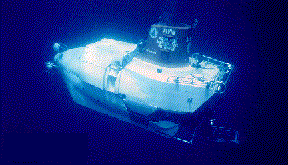
Alvin
Although the U.S. Navy had invested
considerable money and resources in the development of the Trieste II,
there was dissent within the Navy about the importance of exploring
the deep and costs involved. One frustrated Naval expert who was on
the side of progress and wanted to see continued expeditions to the
deep, was Charles Momsen Jr., Chief of Undersea Warfare at the Office
of Naval Research. He eventually convinced the U.S. Naval Offices to
commission a highly maneuverable
deep submergence vehicle (DSV) that would be capable of mounting undersea
rescue missions in the event of another devastating submarine disaster,
such as the sinking of the famous Thresher. Momsen worked closely with
Al Vine of the Woodshole Oceanographic Institute in Cape Cod. In deference
to him, the DSV that was developed out of the U.S. Navy and WHOI partnership
came to be called Alvin, a contraction of the name Al Vine, and the
name has stuck even today.
The Alvin DSV was a streamlined marvel of modern technology
that it still in use today. Alvin is not only highly maneuverable, but
it also has many adaptations included especially for scientific observation
and collection of data and samples. The crew cabin is large enough to
fit three people, although two is the usual number. There are several
viewing ports (windows), external strobe lights with still and video
cameras, as well as remote manipulator arms that can be guided by observers
to collect samples and secure them in an exterior basket to bring to
the surface. The Alvin is one of a fleet of DSVs that have been developed
to explore, catalog, observe and study the deep. Although it was commissioned
by the U.S. Navy, it performs primarily as a scientific vessel. Alvin
has logged over 3,600 dives into the ocean for over 25,000 hours to
an average depth of 2,060 meters. More than 70% of the diving that Alvin
has done has been to make scientific observations and measurements in
geology, geophysics, and biology.
Read about some of the other ways
scientists explore the deep sea...
Trawling | Remote
Cameras (ROVs) | Autonomous Underwater Vehicles
(AUVs)