|
||
|
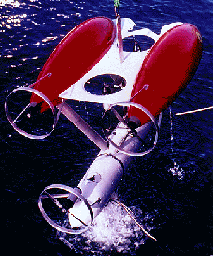
Home> Ocean> Exploring the Deep > Autonomous Underwater Vehicles (AUV) Autonomous Underwater Vehicles (AUV) The ABE undersea robot was engineered to drive itself into deep water and is capable of following the contours of undersea mountains, as well as diving into channels and trenches. It collects several different kinds of data, including conductivity and water temperature, depth, video, magnetic fields, and has on board sonar for advanced sea floor mapping, and geological sampling tools. Editor's note: In March of 2010 the Autonomous Benthic Explorer, known as "ABE", was lost as sea off the coast of Chile while investigating deep sea hydrothermal vents in the Peru-Chile Trench. How did scientists dive to the bottom of the Challenger Deep, the deepest place in the ocean? Meet ABE, which stands for Autonomous Benthic Explorer. |
Get Your Degree!Find schools and get information on the program that’s right for you. Powered by Campus Explorer
|
Copyright © 1998-2015.  Extreme Science is a registered trademark. All rights reserved. Extreme Science is a registered trademark. All rights reserved. |