|
Home > Earth > Volcanoes > Shield Volcanoes
What is a Shield Volcano?
Shield volcanoes are the more quiescent, lumbering giants of the volcano world. Although these types of volcanoes are not small by any means, the eruptions they produce can be pretty "ho hum" compared to the enormous explosive potential of the Extreme Volcanoes. The biggest single mountain in the world is a shield volcano that was slowly built up from the floor of the Pacific Ocean over hundreds of thousands of years - Mauna Loa.
This massive mountain rises just over 13,000 feet from the surface of the Pacific Ocean, but from its true base on the sea bed Mauna Loa towers over 33,000 feet tall. Mauna Loa is one of five massive shield volcanoes that make up the Big Island of Hawaii. This towering giant had some pretty humble beginnings.
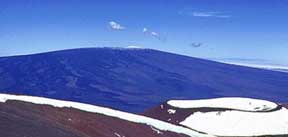 A shield volcano like Mauna Loa owes its shape to the way the lava erupts from a vent in the earths crust that begins as a fissure, or crack. Pockets of superheated magma well up from beneath the crust, causing it to bulge upward. As the sea floor bulges from the movement of the magma, cracks form in the crust, sort of like the way the top of a cake cracks as it bakes in the oven. These fissures in the crust become weak areas of thin crust that give way to the upward force of the magma, eventually allowing it to break through. The overlying weight and pressure of the ocean water affects the way the magma emerges from fissures in the sea floor. The runny lava oozes out of the fissures and spreads out around the crack, cooling as it contacts the seawater. This slow and gradual accumulation of thin layers of lava build up over long periods of time, forming a long, shield-shaped volcano. A shield volcano like Mauna Loa owes its shape to the way the lava erupts from a vent in the earths crust that begins as a fissure, or crack. Pockets of superheated magma well up from beneath the crust, causing it to bulge upward. As the sea floor bulges from the movement of the magma, cracks form in the crust, sort of like the way the top of a cake cracks as it bakes in the oven. These fissures in the crust become weak areas of thin crust that give way to the upward force of the magma, eventually allowing it to break through. The overlying weight and pressure of the ocean water affects the way the magma emerges from fissures in the sea floor. The runny lava oozes out of the fissures and spreads out around the crack, cooling as it contacts the seawater. This slow and gradual accumulation of thin layers of lava build up over long periods of time, forming a long, shield-shaped volcano.
Shield volcanoes are not the only type of volcano that forms on the ocean floor, nor are all shield volcanoes formed only in the sea. As shield volcanoes like the Hawaiian Islands build up from the sea floor they are known as sea mounts - undersea mountains. But once they reach the surface of the sea they become volcanic islands. As the eruptions of fluid lava continue unimpeded by the weight of overlying seawater, the runny nature of the liquid lava continues to build wide mountains with long, gentle slopes. Basalt lava tends to build enormous, low-angle cones because it flows across the ground easily and can form lava tubes that enable lava to flow tens of kilometers from an erupting vent with very little cooling.
What are Stratovolcanoes? ->
|

 Extreme Science is a registered trademark. All rights reserved.